

Solar panels, charging stations, heat pumps, batteries, HVAC. Today, companies have an ever-increasing number of energy sources and consumers. But do they work together as a single system? Rarely. And that costs money. With J’Smart, Group Jansen is changing that. The load management system connects all installations and controls them centrally. The result: lower peaks, a lower energy bill, and greater control.
A brief spike has a lasting impact
Electric cars, charging stations, heat pumps, and rising energy prices are putting pressure on the power grid. For businesses, this means higher peak consumption, additional costs due to the capacity charge, and a real risk of grid congestion. A single 15-minute peak period determines your capacity charge for an entire year.
Anyone looking to expand with additional charging stations or a new production line often runs into the limitations of their existing electrical connection. Upgrading the electrical grid is expensive, involves long wait times, or is sometimes no longer even possible. At the same time, through the Green Deal, Europe is imposing an increasing number of requirements on non-residential buildings. Examples include a building management system (BMS) for larger HVAC systems, charging stations in parking lots, and solar panels on roofs.
“In most buildings, the solution isn’t more capacity, but using what’s already there more intelligently,” says Jo Deceuninck, COO of Business & Solutions at Jansen Smart Solutions.
One brain for all your energy
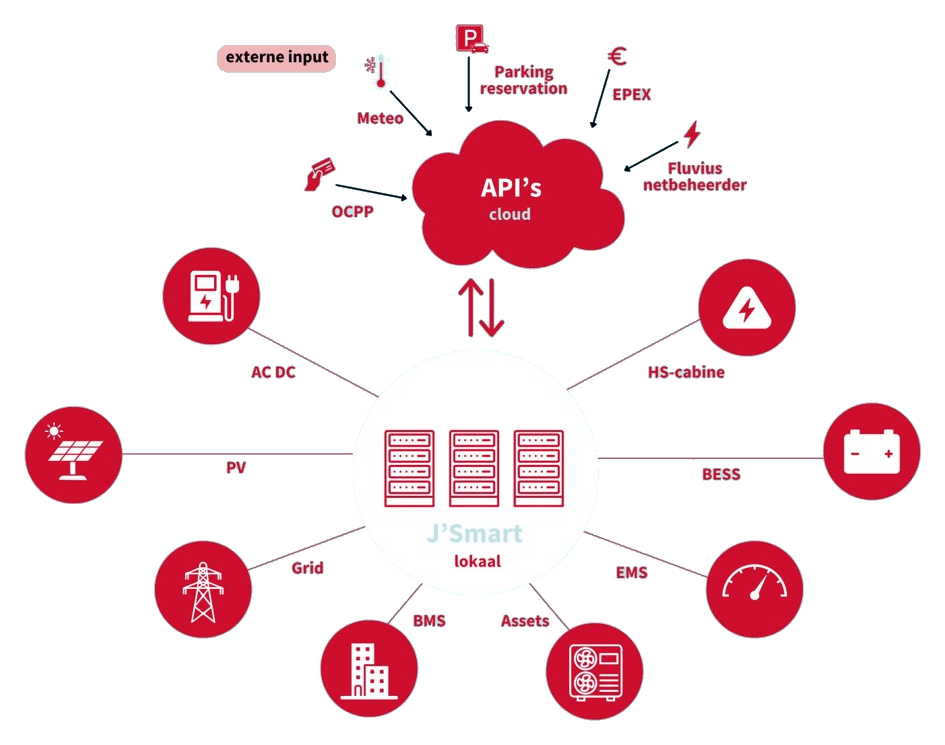
J’Smart is a B2B load management system developed by Jansen Smart Solutions. It continuously measures a building’s energy consumption and generation and automatically adjusts accordingly. This ensures that charging stations, HVAC and heat pumps, battery storage, solar panels, production facilities, and lighting are perfectly coordinated.
In doing so, J’Smart takes into account energy prices on the exchange, solar generation, battery status, available grid capacity, and users’ consumption profiles. AI predictions help anticipate both short- and long-term trends.
The system is brand-independent. Existing charging stations, inverters, and installations remain in place. J’Smart works with or without a BMS and is also suitable for companies with multiple locations. Real-time dashboards and automatic monthly reports provide insight into consumption, production, and storage.
Smart Driving Means Smart Savings
By using energy when it’s cheap and storing it when it’s expensive, you can lower your energy bill—without sacrificing comfort. Peak shaving is the biggest source of savings for most customers. Those who smooth out their peaks get more out of their existing connection and avoid costly grid upgrades. All charging stations combined also stay within the limit, with priorities set per user and charging scheduled for departure times.
A recently completed distribution center proves that it works. Jansen Smart Solutions connected the HVAC system, the electrical installation, and the individual units to each other. By centrally controlling and optimizing everything, energy consumption in EPV mode decreased by 30%.
Three builders, one point of contact
For J’Smart, three companies within the Group Jansen are pooling their expertise. Jansen Smart Solutions builds and programs the control system. Jansen Energy Solutions installs the electrical backbone and the charging infrastructure. And Jansen Technics HVAC-S transforms the HVAC system into a controllable energy consumer.
Together, they explore how sensors, controls, and cabling can be deployed as efficiently as possible. Whenever possible, they combine multiple functions into a single component. This helps you avoid duplicate sensors, extra cabling, and unnecessary devices. From analysis and engineering to installation, programming, and follow-up: you have a single point of contact. And there’s no back-and-forth between suppliers if something goes wrong.